OA Recap: The Secret Behind Block Reordering
Contents
Translated by GPT 5.6 Sol.
Problem Statement
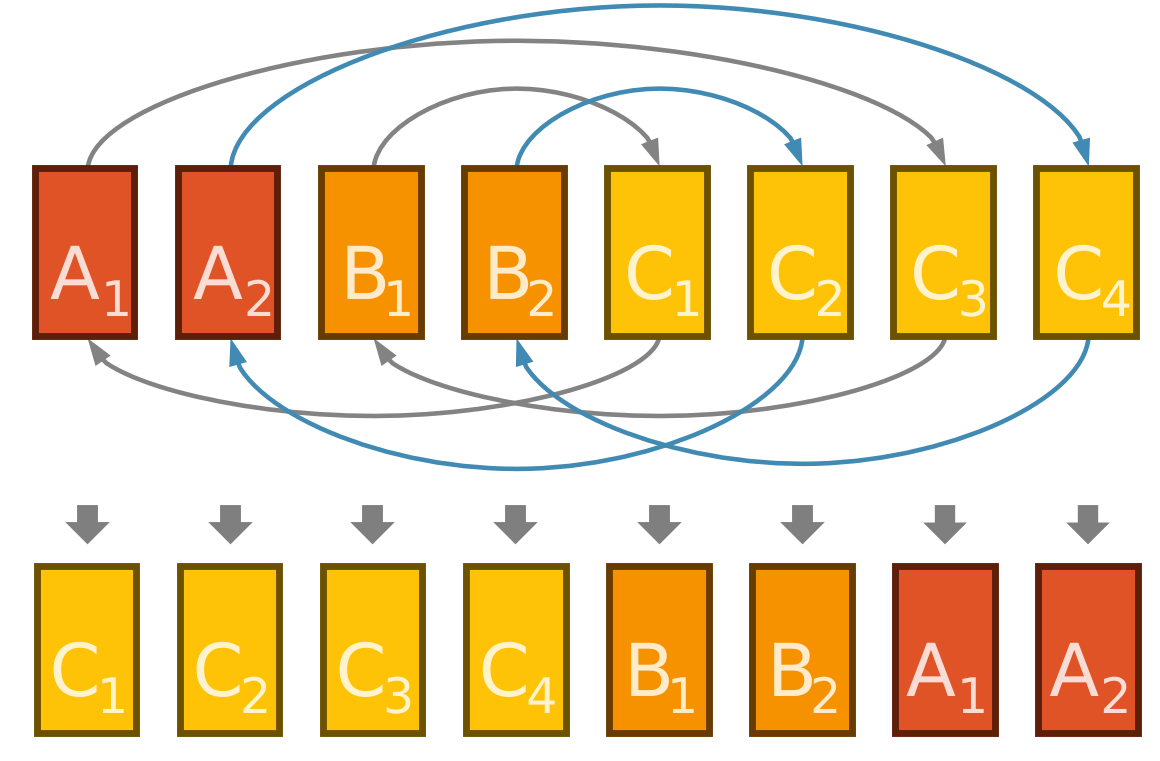
Suppose a row of robots is divided into three groups and initially arranged as . We need to rearrange them into while preserving the relative order within each group. We have one cart and a moveRobot(pos) interface with the following behavior:
- If the cart is empty, the robot at
posis placed on the cart, leaving that position empty. - If the cart is not empty, there are two cases:
- If
poscontains a robot, that robot is moved to the empty position, leavingposempty. - If
posis empty, the robot on the cart is placed atpos.
- If
Given positive integers , simulate the rearrangement and return the number of calls to moveRobot. Fewer calls are better, and a special judge verifies the final arrangement.
unsigned long long robotCount(int n, int m, int k)
{
    // Solution code
}
First Attempt
Without the single-cart restriction, one could simply call memcpy.
Let . The rearrangement is a permutation of the integer interval . Since every permutation decomposes into disjoint cycles1, we can complete the rearrangement by traversing those cycles one at a time.
unsigned long long robotCount(int n, int m, int k)
{
    auto map2prev = [&](unsigned long long x) {
        if (x < k) {
            return x + n + m;
        } else if (x - k < m) {
            return x - k + n;
        } else {
            return x - k - m;
        }
    };

    unsigned long long H = static_cast<unsigned long long>(n) + m;
    bool* moved = new bool[H];
    memset(moved, 0, H * sizeof(bool));

    unsigned long long pos = 0;
    unsigned long long count = 0;
    while (pos < H) {
        if (moved[pos]) {
            pos++;
            continue;
        }
        // Find the first robot that has not been moved.
        moveRobot(pos);
        count++;
        // Process the entire cycle.
        auto move_dest = pos;
        auto to_move = map2prev(pos);
        while (to_move != pos) {
            moveRobot(to_move);
            count++;
            if (to_move < H) {
                moved[to_move] = true;
            }
            move_dest = to_move;
            to_move = map2prev(to_move);
        }
        moveRobot(move_dest);
        count++;
        moved[pos] = true;
        pos++;
    }

    delete[] moved;
    return count;
}
The natural approach above uses a moved array to record which positions have already been visited. Because may exceed the range of int, the indices must use unsigned long long. At the same time, allocating an array of size may throw std::bad_alloc.
Each selected pos represents a permutation cycle that has not yet been processed. This raises a natural question: can we scan only the first positions, where , and still guarantee that we encounter every cycle? Experimentally, , as used above, passes every test case—but is it optimal?
Where the Permutation Cycles Live
Intuitively, some should exist such that every permutation cycle intersects . We now look for the smallest possible value of .
Following map2prev, define a permutation that maps each destination position to the position from which its robot must come:
Subtracting from both sides gives
Notice that . Let . It follows that , or equivalently,
In other words, a cycle never leaves its residue class modulo . In fact, we can prove the stronger statement that every residue class modulo corresponds to exactly one permutation cycle.
For example, take . Then , and decomposes into exactly two cycles: one containing the even positions and one containing the odd positions.
Lemma
For a cyclic rotation by positions of a sequence of length , every permutation cycle is a residue class modulo .
Proof
Let denote the rotation. Starting from , after applications we reach . We return to the starting position exactly when , or . Therefore, the cycle length is the smallest positive integer satisfying , namely
In particular, the cycle length does not depend on .
Since , we have for every . Thus, the orbit starting at stays inside the residue class of modulo . That residue class also contains exactly elements, so it is precisely one permutation cycle.
Now return to the original problem. Construct a new sequence of length :
where is a copy of . Rotating this sequence to the right by positions produces
The first positions after the rotation are exactly the desired rearrangement, with each standing in for . We may therefore identify and . Collapsing these duplicate nodes in the rotation cycles leaves the same cycle partition as —possibly traversed in the opposite direction, which does not change the cycles themselves. By the lemma, every cycle is exactly a residue class modulo
We can now conclude that the smallest valid value of is
The first positions contain one representative from every cycle, so the moved array is no longer necessary and the space complexity drops to . The value is minimal because if , then contains no position with residue modulo and therefore misses the corresponding cycle.
A slightly weaker result is that when , we may take . This version is easier to discover during an online assessment, at the cost of space.
The simulation runs in time. When , only the and blocks need to be exchanged, requiring calls. Otherwise, the total number of calls is
The final implementation is as follows:
unsigned long long robotCount(int n, int m, int k)
{
    auto map2prev = [&](unsigned long long x) {
        if (x < k) {
            return x + n + m;
        } else if (x - k < m) {
            return x - k + n;
        } else {
            return x - k - m;
        }
    };

    unsigned long long H = std::gcd(
        static_cast<unsigned long long>(n) + m,
        static_cast<unsigned long long>(k) + m);

    unsigned long long count = 0;
    for (unsigned long long pos = 0; pos < H; pos++) {
        auto to_move = map2prev(pos);
        if (to_move == pos) {
            // Special case: the robot is already in the correct position.
            continue;
        }
        moveRobot(pos);
        count++;
        auto move_dest = pos;
        while (to_move != pos) {
            moveRobot(to_move);
            count++;
            move_dest = to_move;
            to_move = map2prev(to_move);
        }
        moveRobot(move_dest);
        count++;
    }

    return count;
}
Epilogue
One of the most fascinating aspects of mathematics is how a carefully chosen invariant can decompose a complicated structure into simple, independent pieces. Matrix diagonalization, decompositions of vector spaces, and the use of characteristic equations for homogeneous recurrences all share this theme: identify the structures preserved by a transformation, then study them separately.
In this problem, recognizing the rearrangement as a permutation made its cycles the natural object of study. The repeated addition and subtraction of a few fixed integers suggests divisibility and congruence, which leads to number theory, the greatest common divisor, and residue classes. The proof also illustrates a common lifting technique: embed an awkward problem into a larger, more regular space. What originally looks like a collection of disconnected permutation steps then becomes the projection of a simple rotation. The ability to find such representations is valuable not only in theoretical work, but also when searching for unexpectedly simple systems solutions.